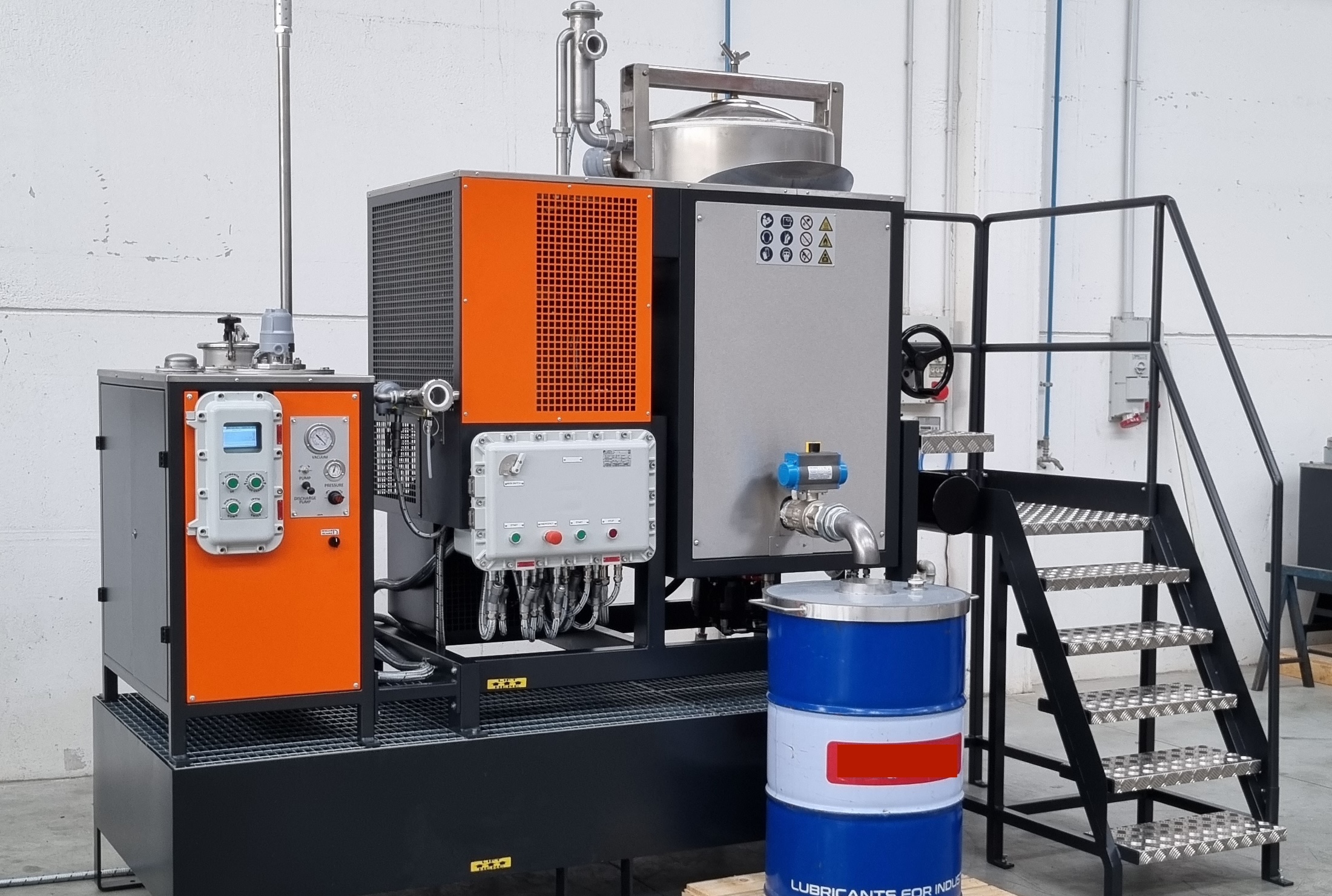
ATEX, Machinery Directive and Compliance: What Must an Industrial Solvent Distiller Guarantee
In the treatment of industrial solvents, regulatory compliance is not a bureaucratic detail.
It is a design requirement that directly impacts:
- operator safety
- production continuity
- civil and criminal liability
- plant insurability
- commissioning approval
When a company purchases a solvent distiller, it is not simply buying a machine.
It is assuming civil and criminal responsibility.
So let’s examine what an industrial distiller must truly guarantee in order to comply with European regulations and operate safely in hazardous environments. distillatore industriale per essere conforme alle normative europee e sicuro in ambienti a rischio.
The European Regulatory Framework: The 4 Key Directives
A solvent distiller placed on the European market must comply with four main directives:
- 2006/42/EC – Machinery Directive
- 2014/35/EU – Low Voltage Directive
- 2014/30/EU – Electromagnetic Compatibility (EMC)
- 2014/34/EU – ATEX Directive
Compliance with these directives is not optional.
It is mandatory for CE marking.
Let’s review them in detail.
Machinery Directive 2006/42/EC
The Machinery Directive requires manufacturers to ensure that machinery placed on the market is safe for users and the environment.
It obliges the manufacturer to:
- carry out a risk assessment and design the machine to eliminate or reduce risks for users
- ensure that materials and construction comply with technical safety specifications
- issue a Declaration of Conformity and affix the CE mark
For an industrial distiller, this means:
- analysis of fire, explosion, and overpressure risks
- controlled temperature management
- protection against accidental contact with hot parts
- automatic shutdown systems in case of anomalies
- certified safety valves
A serious manufacturer does not simply “declare” compliance. It integrates compliance into the design from the engineering phase.
Low Voltage Directive 2014/35/EU – Industrial Electrical Safety
A solvent distiller is a high energy-consumption machine. Inside it are electrical heaters, PLCs, sensors, motors, and fans. For this reason, it falls under the scope of the Low Voltage Directive 2014/35/EU.
This directive applies to electrical equipment with rated voltages between:
- 50–1000 V AC
- 75–1500 V DC
It defines essential safety requirements for placing equipment on the market and putting it into service.
For an industrial distiller, this means the product must be designed and built to minimize electrical and thermal risks.
In particular, it must:
- protect against direct and indirect electric shock
- prevent overheating, electric arcs, and fire
- ensure adequate insulation and protection against accidental contact
- guarantee stable and reliable operation over time
- be supplied with clear instructions for installation, use, and maintenance
The manufacturer must also prepare complete technical documentation and issue an EU Declaration of Conformity.
Only after these steps can the CE marking be affixed.
Compliance with the Low Voltage Directive is not just a regulatory obligation. It is a concrete safety guarantee for operators and facilities. It reduces the risk of failures, fires and downtime and plays a key role in legal liability and insurance coverage.ve.
EMC Directive 2014/30/EU – Electromagnetic Compatibility
Often underestimated, the EMC Directive ensures that the machine does not generate interference affecting other devices and is immune to external electromagnetic disturbances.
Manufacturers of solvent distillers must comply with this directive. Equipment must function correctly in the presence of common electromagnetic disturbances in the operating environment.
Specific emission and immunity tests must therefore be performed. In industrial environments with inverters, motors and complex electronic systems, this aspect is crucial for operational continuity.
ATEX Directive 2014/34/EU – Mandatory in the Presence of Flammable Solvents
When handling solvents, operations almost always take place in environments with a potentially explosive atmosphere.
The ATEX Directive applies to equipment intended to operate in the presence of:
- flammable vapors
- gases
- flammable liquids
- combustible dust
It imposes strict design, construction and testing requirements.
An ATEX-compliant distiller must guarantee:
- certified components suitable for classified zones
- surface temperature control
- prevention of mechanical and electrostatic sparks
- proper grounding
- overpressure protection systems
ATEX compliance is crucial to prevent explosion or fire risks during distillation.
Important: ATEX compliance does not concern only the machine itself.
During installation, a safety zone must be defined around the distiller, normally at least 1 meter, within which all equipment must comply with ATEX regulations.
This means that lighting systems, electrical panels, sockets and measuring instruments must be compatible with the classified zone.
A competent supplier must support the customer during this phase as well.
Beyond Compliance: What an Industrial Distiller Must Truly Guarantee
Regulatory compliance is the foundation.
But a properly designed distiller must go further.
Precise Parameter Control
- PT100 sensors with 0.1°C tolerance
- PLC management with multi set-point control
- ATEX-certified automatic level control
Safe Loading Management
- automatic shutdown upon reaching the correct level
- redundant safety systems
Integrated Fire Protection System
- vapor temperature monitoring
- forced cooling
- pneumatic valve for extinguishing liquid injection
- rupture disc for overpressure
Integrated Containment Tank
- Required by environmental regulations to prevent accidental spills.
Third-Party Certification
- Certification by an independent body increases reliability and strengthens the customer’s legal protection.
The Risks of Non-Compliance
Regulatory non-compliance is not a theoretical risk. It is a concrete vulnerability that can emerge at the worst possible time, often following an inspection, an incident or an insurance assessment.
A non-compliant distiller can lead to the immediate shutdown of the plant by competent authorities, directly affecting production continuity. Administrative penalties may follow and in more serious cases, criminal liability.
Insurance coverage may also be significantly affected: in the presence of non-compliant machinery, the insurer may reduce or deny compensation in the event of a claim.
The user may also be held responsible if installation was not carried out correctly or if the equipment is used in conditions inconsistent with the issued certifications.
In an industrial context, compliance is not merely a technical requirement, it is a tool for legal, financial, and reputational protection. Ignoring it means exposing the company to consequences that go far beyond the cost of a machine.
How to Evaluate a Supplier
QWhen selecting an industrial distiller, it is essential to verify:
- industry experience
- complete compliance documentation
- availability of a technical file
- genuine ATEX certifications
- adequate third-party liability insurance
- structured after-sales service
Safety is never improvised.
It is engineered.
ATEX, the Machinery Directive, EMC, and the Low Voltage Directive are not simple regulatory references to include in a technical data sheet. They are the foundation on which real industrial safety is built.
A solvent distiller operates with flammable substances, high temperatures, potentially explosive vapors, and complex chemical dynamics. In this context, compliance is not a formal obligation, it is a concrete guarantee of protection for operators, the environment, and the company itself.
When a machine is correctly designed according to European directives, the result is not only a compliant system but a stable, reliable and safe installation. It means reducing the risk of downtime, avoiding disputes with authorities, protecting the employer from civil and criminal liability and ensuring long-term operational continuity.
The difference between a machine that is merely “declared compliant” and one truly engineered according to rigorous standards becomes evident in critical moments, process anomalies, mixture variations, challenging environmental conditions. That is when design quality, certification robustness and manufacturer expertise make the difference.
Choosing an industrial distiller therefore means choosing a technical partner.
A company capable of supporting the customer in risk assessment, correct system configuration, classified zone definition and management of the documentation required for commissioning.
Because a distiller is not just a machine that recovers solvent.
It is a system that must operate safely every day, for years, within an increasingly stringent regulatory framework.
And in industrial environments, safety is never optional.
If you are considering the installation of a safe and certified industrial distiller, the Ciemme technical team is available for an in-depth assessment.
Contact us for personalized technical consultancy.