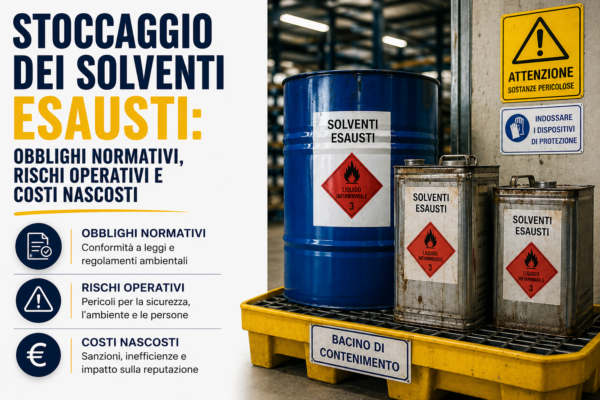
Spent Solvent Storage: Regulatory Obligations, Operational Risks, and Hidden Costs
Solvents play a key role in the cleaning or washing operations of many industrial processes. However, with continuous use, these products gradually become contaminated with process residues, impurities, and dissolved substances, losing the characteristics that allow them to be used effectively. The result is the formation of spent solvent, which must be managed, stored, and subsequently disposed of or treated.
The management and storage of spent solvents is a delicate step from an operational, regulatory, and safety perspective. Solvents may in fact be flammable, generate hazardous vapors, or contain contaminants that require special care during handling and storage.
In addition to these aspects, there are also regulatory implications and disposal-related costs. Solvent storage must comply with safety and environmental requirements, using suitable premises, appropriate containers, and specific procedures to prevent risks to operators and the environment. Furthermore, the transport and treatment of spent solvent involve costs that can significantly affect the overall management of the production process.
For this reason, the storage of spent solvents should not be considered merely a temporary deposit phase, but rather an element of industrial management that requires technical and organizational attention. Understanding how spent solvents are generated, what risks their storage entails, and what regulatory obligations apply enables companies to manage this phase more safely and efficiently.
What are spent solvents and why do they accumulate in production processes?
Solvents are widely used in many industrial sectors as washing, dilution, or extraction agents. Their main function is to dissolve or remove substances present in production processes, facilitating the cleaning of components, surface preparation, or the separation of chemical compounds.
During use, however, solvents inevitably come into contact with impurities and processing residues. Over time, the solvent therefore loses its effectiveness and is no longer suitable for use in the production process, becoming spent solvent. If it is not recovered or treated, it must be temporarily stored pending disposal or collection by authorized operators.
It is precisely at this stage that many of the critical issues related to the management of spent solvents arise: operational safety, regulatory compliance, and management costs.
Main operational risks in solvent storage
The storage of spent solvents requires particular attention because many of the substances used in industrial processes are flammable or potentially hazardous. Moreover, when the solvent becomes contaminated during use, the presence of impurities and processing residues can alter the chemical behavior of the product, increasing the complexity of its management.
One of the main risks is related to the formation of flammable vapors. Many solvents evaporate easily, and the vapors they release can form flammable mixtures with air. Under certain conditions, the presence of an ignition source can cause fires or explosions, especially in poorly ventilated areas or where unsuitable electrical equipment is present.
Vapor density also plays an important role in risk management. Some solvent vapors are heavier than air and tend to accumulate in lower areas of rooms or in less ventilated points, increasing the danger of explosive atmospheres forming. For this reason, proper ventilation of storage areas is a fundamental safety measure.
A further risk factor is the presence of contaminants in the spent solvent. Residues of resins, pigments, oils, adhesives, or other substances from the production process can alter the behavior of the solvent and, in some cases, promote unwanted chemical reactions. Knowledge of the nature of these contaminants is therefore essential in order to correctly assess the methods for managing and storing dirty solvent.
For these reasons, the storage of spent solvents cannot be considered a simple logistical phase. The presence of flammable substances, potentially hazardous vapors, and contaminants requires appropriate management procedures and a proper assessment of operational risks, in order to ensure the safety of operators and the working environment.
Regulations on solvent storage: what a company must do
The storage of spent solvents must comply with current regulations on workplace safety and environmental protection. Since many solvents are flammable or potentially hazardous substances, their management requires the adoption of specific measures to prevent risks to operators, plants, and the surrounding environment.
One of the first aspects to consider concerns the premises used for storage. Areas where solvents are stored must be adequately ventilated to prevent vapor concentrations from exceeding safety limits. Proper ventilation reduces the risk of flammable vapor accumulation and helps maintain safer working conditions for operators.
Another fundamental element is the use of suitable and correctly labeled containers. Solvents must be stored in resistant and perfectly sealed containers, designed to hold chemicals and prevent leaks or evaporation. In addition, containers must clearly display information relating to the product, such as the type of solvent, the manufacturer, and the main safety indications.
Regulations also require particular attention to the separation of incompatible substances. Solvents with different chemical characteristics must not be stored together if there is a risk of hazardous reactions. In particular, flammable substances must be kept away from heat sources and combustible materials, thereby reducing the possibility of accidental ignition.
A further aspect concerns quantitative storage limits. The amount of solvent that may be stored in a given area is not unlimited, but depends on local regulations and the characteristics of the plant. Companies must therefore verify the limits established by the competent authorities and organize solvent management so as not to exceed the permitted quantities.
Fire prevention regulations require that risk assessments also take into account the reduction of the fire load. This aspect also falls within the employer’s obligations under Italian Legislative Decree 81/2008.
Finally, storage areas must be equipped with suitable safety devices, such as fire extinguishers, fire-fighting systems, and containment tanks for any accidental spills. These measures are intended to prevent the dispersion of solvents into the environment and to enable prompt intervention in the event of an emergency.
Compliance with these provisions is a fundamental requirement for ensuring the safe management of spent solvents. For this reason, it is always advisable to verify the regulations applicable to one’s own operating context and, if necessary, consult specialists or qualified suppliers to define the most appropriate solutions.
The company’s responsibilities in managing spent solvents
The management of spent solvents does not only concern operational aspects, but also involves specific regulatory and environmental responsibilities for the company. Contaminated solvents are generally classified as special waste and must therefore be managed in compliance with current safety and environmental protection regulations.
When the solvent is not recovered or treated internally, it must be entrusted to authorized disposal companies, which handle the transport and treatment of the waste according to the procedures required by law. This step is essential to ensure the proper management of spent solvent and reduce the risk of environmental impact.
Solvent management also involves civil and insurance responsibilities. Companies must comply with the storage limits established by regulations and adopt all necessary measures to prevent accidents, such as spills or fires. In many cases, insurance companies require specific coverage related to the management of hazardous substances.
Consequently, the management of spent solvents is also a direct responsibility of the employer. Incorrect organization of storage or disposal can lead to penalties, as well as possible consequences in the event of accidents or environmental damage.
The hidden costs of storing spent solvents
The management of spent solvents involves a series of costs that are often not immediately apparent. In addition to the direct cost of disposal, companies must consider various operational activities related to the collection, storage, and handling of contaminated solvent.
One of the main costs concerns transport and disposal by authorized operators. The price may vary depending on the type of solvent, the quantities, and the method of delivery. Disposal costs may range from approximately €0.45 to over €1 per liter, to which additional transport costs may be added.
These costs are also compounded by the activities required to manage drums and containers used for storage. Solvents must be collected in suitable containers, handled safely, and stored in dedicated areas until collection.
Another often underestimated aspect is the space occupied inside the plant. Storage areas must be organized in compliance with safety regulations and may take up space that could otherwise be used for production activities.
Finally, the management of spent solvents also involves costs related to safety, insurance coverage, and administrative activities, such as the management of registers, transport documents, and the paperwork required for waste delivery.
Taken together, these elements show that the storage of spent solvents is not just a logistical phase, but a cost item that can significantly affect the organization and efficiency of the production process.
Reducing storage: solvent regeneration
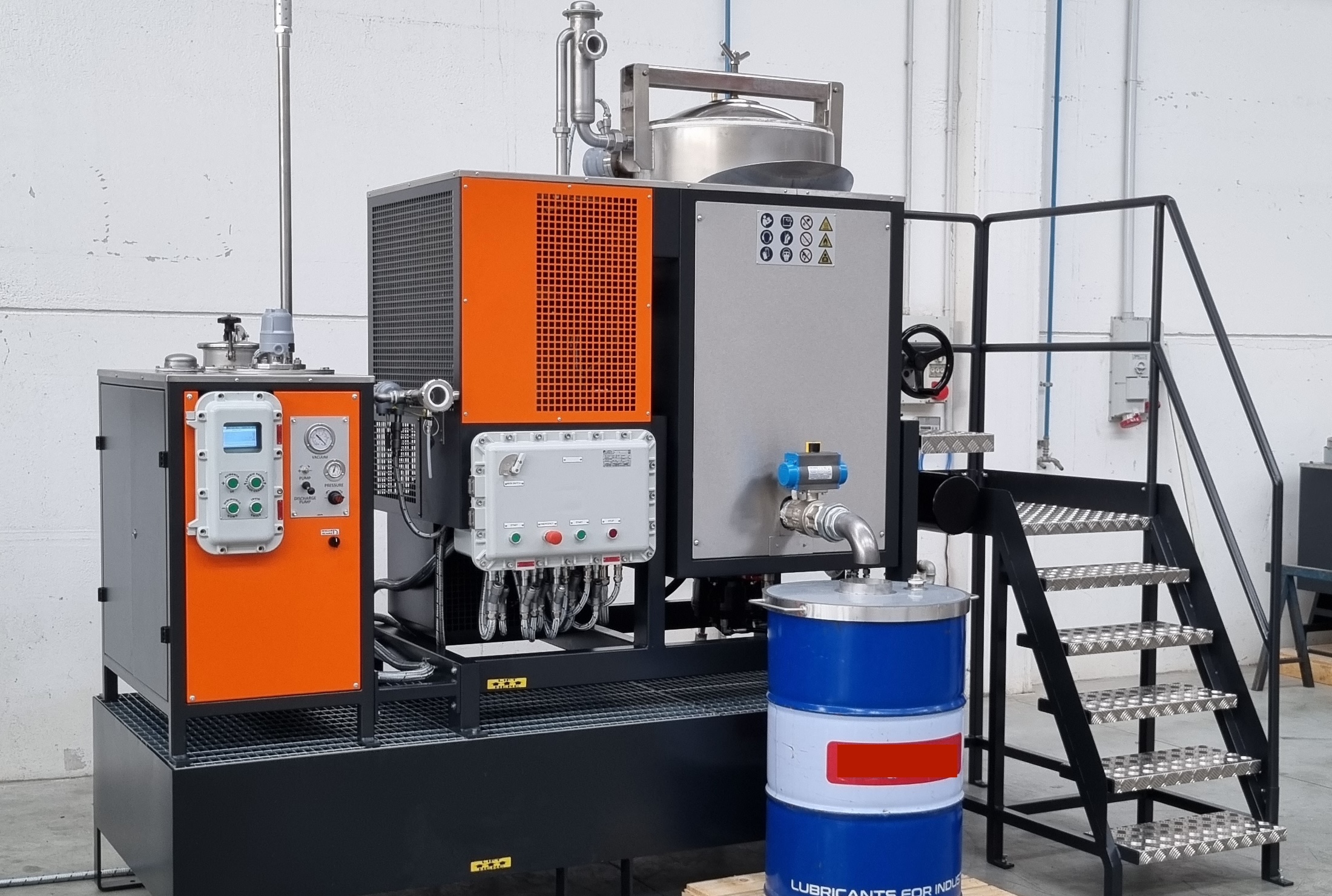
One of the most effective strategies for reducing the storage of spent solvents is recovery through distillation. This process separates the solvent from the impurities and contaminants accumulated during use, making it available again for the production process.
Solvent recovery significantly reduces the amount of waste to be stored and disposed of. As a result, costs related to transport, container management, and the space required for storing spent solvent are also reduced.
In addition to the economic advantage, solvent regeneration is also a more sustainable solution from an environmental perspective. By reusing the recovered solvent within the production process, companies can reduce the consumption of new raw materials and limit the impact associated with chemical waste disposal.
The storage of spent solvents is not only an environmental or regulatory issue, but an aspect that directly affects the organization and costs of production processes.
For this reason, many companies are beginning to consider solvent management no longer as a simple disposal phase, but as a process to be optimized. Rethinking solvent management therefore means transforming a process residue into a resource, with benefits from both an economic and operational perspective.