How long does regenerated solvent last? What happens during each distillation cycle
Regenerated solvent isn’t “as good as new” forever. Here’s what changes chemically with each cycle, how many reuses are realistic, and when it’s time to stop.
Anyone considering installing a distillation unit almost always arrives at a question that rarely gets a clear answer: fine, I recover the solvent, but for how long can I keep reusing it?
It’s a legitimate question, and the honest answer is: it depends. Not on a single factor, but on the combination of three elements: the type of solvent, the type of contaminant, and the parameters of the distillation cycle used to regenerate it.
There’s one expectation that needs correcting straight away, because it’s at the root of almost every question on this topic: distillation regenerates, it doesn’t “reset” indefinitely. A well-distilled solvent returns to the same physico-chemical characteristics as pure solvent, but that doesn’t mean it can be recycled forever without any attention. Let’s look at why.é.
What happens chemically during distillation
The principle is simple: the dirty solvent is heated to the boiling point of the solvent present in the mixture. The vapour that forms is almost exclusively pure solvent: the contaminants, which in most cases have a much higher boiling point, remain in the boiler. Next, the vapour is channelled into a condenser, which returns it to a liquid state, ready to be reused.
The key point to understand is this: distillation separates, it doesn’t transform. The condensed solvent has the same molecular structure as pure solvent: it isn’t “regenerated” at a chemical level, it’s simply freed from the contaminant it was mixed with. This is why, if the process is carried out correctly, the recovered solvent can genuinely have the same properties as virgin solvent.
But precisely because distillation is a physical separation process, there are two things it cannot do:
- it doesn’t remove substances with a boiling point very close to that of the solvent: in these cases, part of the contaminant “passes through” together with the vapour;
- it doesn’t undo chemical alterations that have already occurred before distillation — for example, oxidation that developed during prolonged storage of the spent solvent.
This second point is crucial, and it brings us to the next question.
Does the solvent lose quality? What can actually degrade
It’s worth distinguishing between two concepts that are often confused: a solvent can be dirty (it contains a contaminant that distillation removes) or degraded (the solvent molecule itself has been chemically altered). The first case is resolved by distillation; the second is not.
Three of the most common degradation mechanisms are:
- Acidification. Many industrial solvents — ketones, alcohols, glycols, esters, aromatics — are generally neutral but can acquire acidic properties. This typically happens due to prolonged, improper storage before distillation (the solvent oxidises on contact with air), or when critical temperatures for heat-sensitive solvents are exceeded during distillation.
- Peroxide formation. Some solvents — tetrahydrofuran, diethyl ether, alkoxides, ketones — can develop peroxides over time, potentially unstable substances that need to be monitored carefully.
- Acidification of halogenated solvents. Chlorinated and fluorinated solvents are particularly prone to developing acidity during use and distillation: for these solvents, a stainless-steel condenser and vacuum distillation are recommended.
The point worth emphasising is that it isn’t distillation itself that “degrades” the solvent. It’s prolonged exposure to unfavourable conditions — improper storage, excessively high temperatures, contact with reactive contaminants — that alters its structure. A well-run distillation cycle, at the correct temperatures and with the right precautions, doesn’t degrade the solvent: it simply separates it from the contaminant.
How many distillation cycles can a solvent withstand?
There’s no universal number that applies to every solvent: the number of possible cycles depends on how the type of solvent, the type of contaminant, and the quality of the distillation process interact.
That said, some factors genuinely extend the useful life of a regenerated solvent:
- Precise process control. High-precision temperature sensors, vacuum distillation for heat-sensitive solvents, a correctly sized condenser: all of this reduces the thermal and chemical stress the solvent is subjected to at each cycle.
- No mixing with incompatible solvents. Accidentally mixing different solvents, or failing to properly separate batches, can trigger unwanted reactions that drastically shorten the product’s useful life.
- Correct storage before distillation. Spent solvent left for months in unsuitable conditions can oxidise before it even reaches the distillation unit.
To get a more concrete idea, here’s how the main solvent families generally behave:
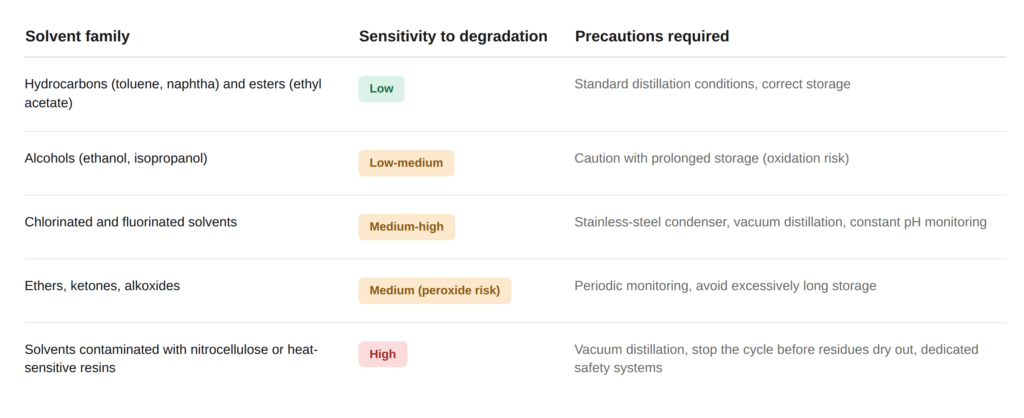
Generally speaking, a well-designed distillation unit allows up to 90% of the dirty solvent to be recovered at each cycle. The remaining 10% is residue (concentrated contaminant) to be disposed of: this is a physiological part of the process, not a sign of solvent degradation.
When should the solvent be replaced? Signs to monitor
Even solvent treated under the best conditions eventually needs replacing. The signs to monitor are both chemical-physical and practical.
Chemical-physical signs:
- an abnormal pH shift compared with the reference pure solvent;
- a change in the distillate’s colour: a sign that something is passing through with the vapour, or that the solvent is deteriorating;
- an increase in boiling point compared with the pure solvent: a contaminated or degraded solvent tends to evaporate at a higher temperature than the same product under normal conditions.
Practical signs in production:
- loss of degreasing or cleaning power during washing;
- longer washing or cleaning times needed to achieve the same result;
- less consistent results in processes that depend on the solvent (painting, printing, extraction).
The most reliable way to avoid relying solely on empirical experience is periodic monitoring: pH checks, visual inspection through the sight glass at the condenser outlet — present on many professional distillation units — and, where the solvent plays a critical role in the production process, laboratory analysis when needed.
Which contaminants degrade the solvent most (and which don’t)
Not all contaminants have the same impact on the solvent’s useful life.
- Contaminants that don’t compromise quality over time. Oils and inks generally have a very high boiling point: although they must always be declared to the distillation unit manufacturer so the system can be configured correctly, they don’t affect the solvent molecule or accelerate its degradation.
- Contaminants that require attention. Resins, pigments, paints, polymers, and adhesives may require specific distillation unit configuration (for example, automatic boiling chamber cleaning systems) to be managed without compromising cycle efficiency over time.
- Critical contaminants. Substances such as nitrocellulose, peroxides, nitric compounds, and nitroaromatics require more thorough assessment. Nitrocellulose, for example, can decompose if heated to a dry state, releasing toxic fumes and posing a risk of self-ignition at around 170–180°C: when this contaminant is present, it’s essential to stop the distillation cycle before the residue dries out completely, and to equip the plant with a dedicated fire-suppression system.
Always declaring the exact nature of the contaminants present to the supplier isn’t a bureaucratic formality: it’s what allows the distillation unit to be configured correctly and, as a result, genuinely extends the solvent’s useful life.
How a well-designed distillation unit extends the solvent’s life
The factor that most affects the longevity of a regenerated solvent isn’t the number of cycles itself, but how each individual cycle is carried out.
Vacuum distillation, for example, reduces the boiling point required and helps avoid the critical thresholds that can trigger self-ignition or decomposition of contaminants: a direct advantage for the chemical stability of the treated solvent.
Precise process control (high-precision temperature sensors, automatic parameter management) ensures that every cycle takes place under the same optimal conditions, without the fluctuations that can needlessly stress the solvent over time.
In essence: a “pushed” distillation process — temperatures too high, times too long, lack of control — is the primary cause of accelerated degradation. Not the fact of distilling the same solvent multiple times.
A correctly regenerated solvent, treated with a distillation unit properly configured for the type of solvent and contaminant, can be reused for a great many cycles. The real limit isn’t “the passage of time,” but the combination of the solvent’s characteristics, the nature of the contaminants, and the quality of the process used to distil it.
To find out more precisely how many cycles to expect in your specific case, the starting point is always the same: the solvent’s safety data sheet and, when a truly reliable answer is needed, an actual distillation test.
Do you have questions about the useful life of the solvent you’re treating, or want to understand how to set up your distillation cycle correctly? Get in touch: we’ll help you assess the best solution for your situation.