What does spent solvent really cost? How to calculate it
The real cost of spent solvent is not just the disposal contractor’s fee (roughly €0.45–1 per litre), but the sum of new solvent purchases, disposal, transport, storage, staff hours, environmental compliance, safety and inefficiencies. In a company that uses 20,000 litres a year, the full cycle can cost over €50,000; with in-house recovery by distillation (80% yield) the cost drops to around €19,500, with a payback on the equipment of just a few months.
How much does every litre of dirty solvent cost your company?
Usually the answer stops at two figures: the price of new solvent and the disposal contractor’s fee. These are the items that appear on invoices, so they are the easiest to see. Between the moment solvent enters the plant and the moment it leaves as waste, however, there are transport, occupied space, working hours, registers and forms, safety procedures. Taken one by one, these are small costs. Added up over a year, they become a figure worth knowing.
In this article we look at which items to consider, how to estimate them and where to find the data, with a worked example comparing current management with in-house solvent recovery by distillation.
The solvent cycle: where costs arise
Spent solvent is solvent that, after being used for washing or cleaning, has picked up so many contaminants (inks, paints, resins, oils) that it can no longer be used and becomes waste, in most cases classified as hazardous.
Take a department where solvent is used to wash components, machines or equipment, as happens in industrial printing, paint and coating production or pharmaceuticals. New solvent arrives, is used and gradually gets dirtier until it becomes spent solvent.
If it is not recovered in-house, the cycle repeats itself unchanged: the dirty solvent is stored, collected and sent to an authorised facility, while more new solvent has to be bought to replace it. To know its real cost, you need to line up everything that happens between purchase and collection.
Spent solvent cost items to consider
Purchasing new solvent
This is the most obvious item: average cost per litre × litres purchased in a year. The figure is already in the accounts, but it is worth looking at in perspective too. Solvent prices can vary considerably from one year to the next and, the more new solvent is needed, the more exposed the company is to these fluctuations and to supplier availability.
There is also an aspect that changes the meaning of this item: dirty solvent often still contains a high share of reusable solvent. Every litre recovered through distillation and put back into the process is a litre that doesn’t have to be bought again.
Spent solvent disposal
The cost of spent solvent disposal is the fee paid to the authorised operator to collect and treat the contaminated solvent. It is calculated by multiplying the litres (or kilos) sent for disposal in a year by the unit cost, which depends on the EWC code (European Waste Catalogue), the type and percentage of contaminants, the quantities and the geographical area. As we saw in the article on spent solvent storage, figures range roughly from about €0.45 to over €1 per litre.
Purchasing and disposal should be read together: every litre sent out is, in effect, a litre to be bought again.
Solvent transport and collections
Depending on the contract, transport may be invoiced separately or included in the disposal fee. Either way it is a cost, and it grows with the number of collections.
The frequency of collections depends on the volumes produced and the space available, but also on the rules for temporary storage (art. 185-bis of Italian Legislative Decree 152/2006). In Italy, waste must be sent for recovery or disposal at least every three months or, alternatively, when the storage reaches a total of 30 cubic metres, of which no more than 10 of hazardous waste; in any case, temporary storage cannot exceed one year. The more spent solvent is produced, the more often the disposal contractor has to be called.
Spent solvent storage
Before collection, contaminated solvent takes up drums, tanks or IBCs in containment bunds and in a dedicated area, with requirements for ventilation, labelling and distance from ignition sources. On top of this comes the space for new solvent waiting to be used.
That is floor space taken away from production or the warehouse, plus equipment to buy and maintain. To estimate its value, you can assign the storage area the same cost per square metre that the company bears for the rest of the plant, in rent or depreciation. The obligations and risks of storage are covered in depth in our dedicated article on spent solvent storage.
Handling and staff hours
Solvent doesn’t move by itself. It has to be transferred from the machines to the collection area, decanted and prepared for collection; new solvent has to be received, stored and brought where it is needed. Around these steps there are less visible activities: level checks, coordination with the disposal contractor, orders to suppliers, quantity checks.
Taken individually, these are short tasks: half an hour here, an hour there. To estimate them, you can start with one question: how many hours a month do staff spend managing solvent, outside of production work? Multiplied by the company’s hourly cost and by twelve months, they give an item that rarely appears in solvent cost calculations.
Registers, forms and environmental compliance
Spent solvent is waste and, as such, comes with a flow of paperwork. In Italy it requires classification and assignment of the EWC code, the chronological loading and unloading register, the waste identification form (FIR) for each transport and the annual MUD environmental declaration. Producers of hazardous waste must also register with RENTRI, the national electronic waste traceability register, an obligation now extended to all initial producers of hazardous waste: registers and forms are managed in digital format.
These activities are carried out by in-house staff or external consultants and, either way, they have a cost, even if it doesn’t appear on the disposal contractor’s invoice. The workload also increases with the number of movements and collections to be recorded.
Safety and risk management
Many industrial solvents are flammable and their vapours can form explosive atmospheres. Storage, decanting and use therefore require risk assessment, procedures, training, protective equipment and, where necessary, ATEX zone classification. The more new and spent solvent circulates in the plant, the wider the exposure to be managed.
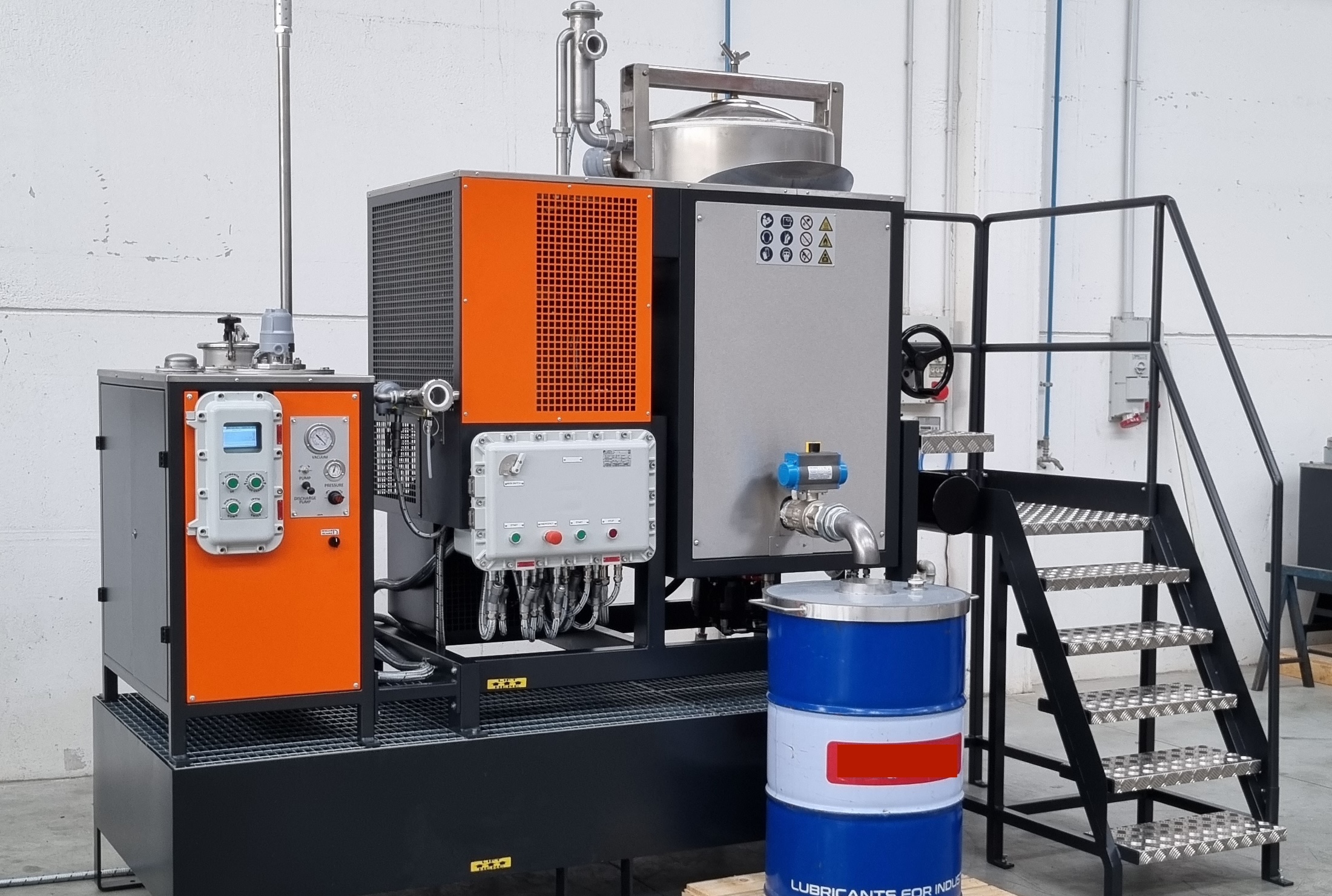
Putting a precise value on risk is not easy, but it is a factor to consider when comparing different management models. It also works the other way: a recovery system must be designed and installed according to specific requirements, which is why the CIEMME range includes ATEX-certified distillers for installation in Zone 1.
Downtime and operational inefficiencies
The last item is the least obvious. Operators leaving the machine to decant solvent or move drums, waiting times, containers to manage, clean solvent running out just when it’s needed.
They rarely cause actual machine downtime; more often they translate into small productivity losses spread over time. Precisely because they are small, nobody usually measures them.
The formula for calculating annual solvent cost
The annual cost of solvent management is the sum of all the items in the cycle, from purchase to waste collection:
Annual cost = new solvent purchases + disposal + transport + storage + handling and staff hours + environmental compliance + safety + operational inefficiencies
Some items can be read straight from invoices, others have to be estimated. The table shows where to start.
| Item | How to estimate it | Where to find the data |
|---|---|---|
| New solvent purchases | Litres purchased × average price | Supplier invoices, purchasing system |
| Disposal | Litres or kg sent for disposal × fee | Disposal contractor invoices, loading and unloading register |
| Transport | Number of collections × cost per collection | Invoices, waste identification forms (FIR) |
| Storage | m² occupied × cost per m² + equipment | Floor plan, depreciation schedule |
| Handling and staff | Hours per month × hourly cost × 12 | Estimate from department managers |
| Environmental compliance | In-house hours or consultant’s fee | Consultancy contracts, office time |
| Safety | Share of training, PPE and equipment related to solvent | Risk assessment document (DVR), safety budget |
| Operational inefficiencies | Minutes lost per shift × hourly cost | Washing and set-up times |
Absolute precision isn’t needed: even a conservative estimate of the hidden items changes the picture compared with simply weighing purchasing against disposal.
Worked example: current management vs in-house recovery
Let’s consider, purely as an example, a company that buys 20,000 litres of solvent a year. Part of it evaporates during use, leaving 18,000 litres of spent solvent to manage.
For the current scenario we assume a new solvent price of €2.00/l, a disposal cost of €0.50/l (at the lower end of the range given above), €3,000 a year for transport and collections and €2,000 for handling, in-house management and administrative tasks.
For the in-house recovery scenario, we instead assume:
- a distillation yield of 80%: 14,400 litres are recovered from the 18,000 litres of dirty solvent, and the new solvent to be purchased drops to 5,600 litres;
- 3,600 litres of residue to dispose of, with a conservatively higher unit cost (€0.80/l) because it is more concentrated (in practice, distillation residue is often invoiced by weight);
- transport reduced to €1,000 thanks to lower volumes;
- in-house management unchanged at €2,000: less solvent is moved to the storage area, but the distiller has to be loaded and emptied;
- an energy cost of €0.08 per litre treated and €1,000 a year for maintenance and consumables.
| Item | Current management | With in-house recovery |
|---|---|---|
| New solvent purchases | 20,000 l × €2.00 = €40,000 | 5,600 l × €2.00 = €11,200 |
| Disposal | 18,000 l × €0.50 = €9,000 | 3,600 l × €0.80 = €2,880 |
| Transport and collections | €3,000 | €1,000 |
| In-house management and compliance | €2,000 | €2,000 |
| Energy for distillation | – | 18,000 l × €0.08 = €1,440 |
| Maintenance and consumables | – | €1,000 |
| Annual total | €54,000 | €19,520 |
Looking only at the disposal contractor’s invoice, spent solvent would cost this company €9,000 a year. Considering the entire solvent cycle, from purchase to disposal, the figure rises to €54,000. With in-house recovery, the annual cost drops to around €19,500, a difference of about €34,500 a year.
We have not included storage, safety and operational inefficiencies in the calculation. These are items that recovery tends to reduce: leaving them out makes the comparison more conservative.
How to calculate the payback of a solvent distiller
The payback of a distiller is the time it takes for the annual savings to pay back the initial investment:
Payback (years) = initial investment ÷ net annual savings
In the example, the savings are already net of energy and maintenance, so every €10,000 invested in the system would be recovered in about three and a half months (10,000 ÷ 34,480 × 12 ≈ 3.5). The investment should include the distiller, installation and any accessories, such as pumps, tanks or containment bunds.
The values used are hypothetical and serve to illustrate the method: prices, fees, yields and consumption vary from company to company.
What changes with solvent recovery
Distillation separates the solvent from the contaminants accumulated during use and, where the characteristics of the product and the process allow, makes it possible to reuse it. The economic balance changes on two main fronts: less new solvent is purchased and the volume of waste to be disposed of is reduced. As a result, collections, stored quantities and paperwork also decrease, and the company depends less on external suppliers.
In-house recovery has its own costs too: investment, energy, maintenance and process management must be included in the analysis, as must the quality of the regenerated solvent over time, which we discussed in How long does regenerated solvent last?. This is why the cost-effectiveness of a distiller is not assessed starting from the price of the machine, but by comparing the total cost of current management with that of the process once recovery has been introduced.
Before investing: the distillation test
Not all solvents and not all processes are the same. The composition of the contaminated solvent, the type and percentage of residues, the quantities used, the boiling point and the chemical and physical characteristics all affect both whether recovery is possible and the yield.
This is why CIEMME carries out distillation tests on solvent samples taken from the customer’s production process. The test measures the recovery yield, the amount of residue to be disposed of, the quality of the distillate and the cycle time, and indicates the most suitable system configuration. These are exactly the data needed to redo the calculation in this article with the company’s real figures. We explain how the assessment works in Can your solvent be recovered?.
Frequently asked questions about spent solvent cost
How much does it cost to dispose of spent solvent? In Italy, the fee for sending it to an authorised facility ranges roughly from €0.45 to over €1 per litre, depending on the EWC code, the type and percentage of contaminants, the quantities and the geographical area. Transport may be included or invoiced separately.
What hidden costs does spent solvent have beyond disposal? Transport and collections, storage space with containment bunds, staff hours for handling and decanting, environmental compliance (register, FIR, MUD, RENTRI), safety and ATEX, and small operational inefficiencies. Added up over a year, they often exceed the disposal contractor’s invoice.
How do you calculate the annual cost of solvent? By adding up new solvent purchases, disposal, transport, storage, staff hours, environmental compliance, safety and inefficiencies. The first three items can be read from invoices; the others are estimated with hours × hourly cost or m² × cost per m².
How much can you save with a solvent distiller? It depends on volumes, solvent price and distillation yield. In the example in this article (20,000 l/year, 80% yield) the annual cost goes from €54,000 to around €19,500, a saving of about €34,500. With a 60% yield, the savings remain at around €24,000.
How long does it take for a distiller to pay for itself? The payback is calculated by dividing the investment by the net annual savings. In the example, every €10,000 invested is recovered in about three and a half months. The real yield, measured with a distillation test on the customer’s solvent, is the figure with the greatest impact.